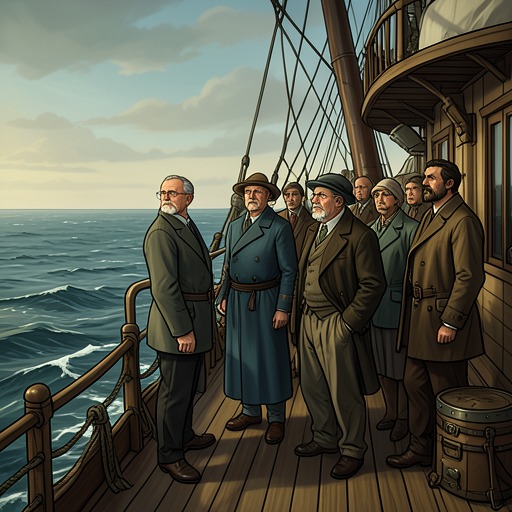
Scurvy during the voyage
The EmigrantsScurvy during the voyage is the prolonged illness that shadows the emigrants’ crossing on the Charlotta, weakening Kristina and other passengers and culminating in the captain’s recognition of scurvy when Kristina suffers severe bleeding. The narrative connects the disease to the conditions of the passage—crowded accommodation, strict limits on fresh water, and food kept in storage—while showing how bodily suffering could be interpreted through both practical observation and religious belief.
A Crossing and Its Conditions
The Charlotta sailed from Karlshamn for New York on April 14, 1850, carrying 78 emigrants among 94 people aboard. The vessel was a 124-foot brig on its seventh voyage as an emigrant ship. Its hold had been divided into three compartments, but once passengers brought in their bedding, food baskets, knapsacks, and bundles, the space became cramped and poorly aired. There was little room to move, and light entered chiefly through the main hatch.
The ship’s mate laid out a weekly ration of unprepared provisions and instructed passengers to make them last. Each person could obtain half a gallon of fresh water per day for drinking and washing; the allowance could not be increased, since the passage might last three months in unfavorable weather. Passengers had to clean their quarters before receiving their water. The routine made sanitation a shared daily task, but it also exposed the tight limits within which the emigrants had to manage food, washing, and illness.
Symptoms and Passengers’ Explanations
As the weeks passed, Kristina recovered from seasickness enough to get up and eat almost regularly, but she remained weak and sluggish. She felt pressure in her chest and shortness of breath, symptoms also reported by other passengers. Her children grew pale, lost their appetites, and refused the ship’s salty food. The family had gone a month without milk, and the small reserves of sugar, cakes, honey, and dried apples that had comforted the children were gone.
Kristina’s condition worsened rather than resolving with her initial seasickness. Her limbs and joints ached, she had pain in her lower back, and she was repeatedly seized by chills. Weakness and fatigue made ordinary tasks difficult; she increasingly left chores to Karl Oskar and feared that she had become a burden to him. Karl Oskar attributed her poor health partly to the ship’s fare, which consisted of old salted food and supplies that had been stored for a long time. He noted that others complained of similar weakness and concluded that life at sea was damaging to the body.
The narrative gives the illness a name without treating it as an immediate explanation available to every passenger. Kristina may have heard of scurvy, a word that seemed to her to suggest something spoiled or contaminated. The disease was also called ship-sickness. She privately feared that her illness was more than seasickness and understood it as a threat to her life. Her fear recalled the warning she believed she had received before departure: that she did not belong at sea. This religious interpretation coexisted with the physical evidence of deteriorating health and the poor conditions aboard.
Illness in a Crowded Shipboard World
Kristina’s suffering was not isolated. She had noticed Inga-Lena’s decline during the voyage: Inga-Lena continued to care for her husband and children and to take on heavy chores, even as dizziness, headaches, fainting, and persistent illness left her increasingly weak. Her case demonstrates how the demands of shipboard household labor continued even when a passenger was unwell. The ship’s rules required passengers to keep the hold clean, while the restricted water supply and crowded quarters made everyday care difficult.
The account also sets illness beside the vulnerability of children and families. Nineteen children had left Karlshamn aboard the brig; two died during the crossing, and the surviving children were considered in good health at that point. These deaths are not identified as scurvy, and the narrative distinguishes them from the disease Captain Lorentz later recognizes in Kristina. Their presence nevertheless places her illness within a voyage where the emigrants’ hopes for a new life were already accompanied by sickness and loss.
Recognition and Narrative Significance
When Kristina suffers a grave hemorrhage, Captain Lorentz consults his Medical Adviser for Seafarers. The manual describes how prolonged bleeding could become dangerous and gives directions for attempting to stop it. After seeing Kristina and the blood she has lost, Lorentz recognizes that she has suffered from scurvy for a long time. His diagnosis brings together the symptoms accumulated over the passage and the medical knowledge available to the ship’s commander.
The captain’s recognition does not erase the gap between diagnosis and outcome: he believes that Kristina’s blood loss has become life-threatening. In this way, scurvy gives the voyage a material counterpoint to its promises of escape and renewal. The illness is neither simply a test of faith nor merely a passing inconvenience; it is an embodied consequence of a difficult crossing, with food, space, water, labor, and access to care shaping how emigrants endure it. The narrative preserves both the passengers’ interpretations and the captain’s medical judgment without claiming that religious belief alone explains or cures the disease.